

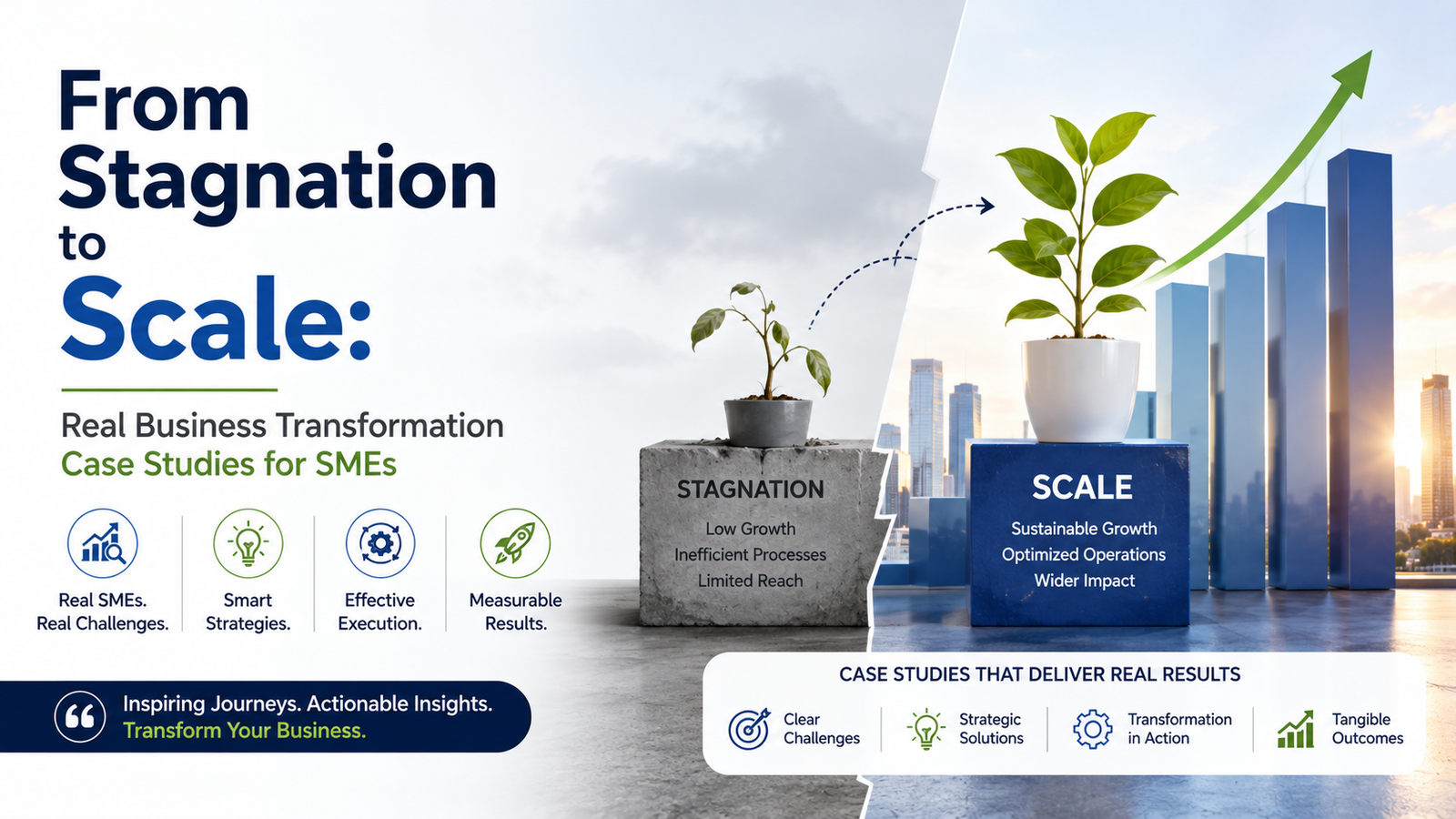
Every SME founder hits a wall eventually. Revenue plateaus, processes creak under pressure, and the strategies that once worked stop delivering results. This is the moment where business transformation stops being a buzzword and becomes a necessity. For small and mid-sized businesses in Singapore’s fast-moving economy, understanding what real transformation looks like — through actual outcomes, not theory — is often the difference between stagnation and sustainable scale.
This article breaks down what business transformation actually involves, why it matters more than ever for SMEs, and how companies have used it to move from flatlined growth to measurable momentum.
Why SMEs Stagnate Before They Scale
Stagnation rarely happens overnight. It builds up slowly, through a series of small inefficiencies that compound over time. Common causes include:
- Outdated operating models that worked at a smaller scale but can’t support growth
- Founder-dependent decision-making that creates bottlenecks
- Inconsistent sales processes that rely on individual effort rather than repeatable systems
- Limited visibility into data, making it hard to know what’s actually driving (or blocking) revenue
- Reactive leadership, where teams are constantly firefighting instead of planning ahead
These patterns are especially common among SMEs that experienced early success through hustle and instinct, but never built the infrastructure to sustain it. This is precisely where structured business transformation in Singapore becomes valuable — not as a one-time fix, but as an ongoing discipline.
What Business Transformation Actually Means
Business transformation isn’t a rebrand or a new logo. It’s a deliberate, structured shift in how a company operates — spanning strategy, systems, people, and culture. Done properly, it touches:
- Revenue and sales processes
- Operational workflows
- Leadership decision-making
- Team accountability structures
- Customer experience delivery
The goal isn’t change for its own sake. It’s building a business that can scale predictably, without the founder personally holding every process together.
Case Study Patterns: What Real Transformation Looks Like
While every SME’s journey looks different, certain transformation patterns consistently show up across industries. Below are composite patterns drawn from common SME turnaround scenarios that illustrate how structured change plays out in practice.
Pattern 1: From Founder-Led Chaos to Systemized Growth
A common starting point for many SMEs is a business entirely dependent on its founder — every deal, decision, and client relationship funnels through one person. Growth stalls because there simply aren’t enough hours in the day.
The transformation typically involves:
- Documenting core processes so they’re no longer trapped in one person’s head
- Building a sales framework the whole team can follow consistently
- Delegating decision-making authority to trained team leads
- Introducing regular performance reviews tied to clear metrics
The result is a business that can grow without the founder personally managing every transaction — a foundational shift that consulting firms like Motivus Consulting regularly guide SME leaders through.
Pattern 2: From Order-Taking Sales to Consultative Selling
Many SMEs default to reactive, order-taking sales — responding to inbound requests rather than proactively identifying customer needs. This caps growth because it relies entirely on existing demand.
Shifting to a consultative selling approach — where the sales team diagnoses the client’s actual problem before pitching a solution — typically drives:
- Higher average deal value, since solutions are tailored rather than generic
- Stronger client retention, because trust is built through genuine problem-solving
- More predictable pipelines, since conversations start earlier in the buying journey
This shift is one of the most common levers in business transformation work, and one of the fastest to show measurable impact on revenue.
Pattern 3: From Gut-Feel Decisions to Data-Backed Diagnostics
SMEs that scale successfully tend to replace intuition-only decision-making with structured revenue diagnostics — a clear-eyed audit of where growth is being lost across sales, marketing, and operations.
A typical diagnostic-led transformation includes:
- Mapping the full customer journey to identify drop-off points
- Auditing pricing, positioning, and messaging for gaps
- Reviewing team capability against growth targets
- Setting a prioritized 90-day action plan based on findings
This diagnostic-first approach ensures transformation efforts are targeted at the highest-impact areas rather than spread thin across the entire business.
Why Singapore SMEs Face Unique Transformation Pressures
Business transformation in Singapore carries its own specific dynamics. The market is compact but highly competitive, talent costs are rising, and digital-first customer expectations are moving faster than many legacy SME operations can keep up with. At the same time, Singapore’s SME support ecosystem — from grants to advisory programs — creates real opportunity for businesses willing to formalize their growth strategy rather than relying on ad hoc tactics.
SMEs that treat transformation as a structured, ongoing process — rather than a one-off crisis response — tend to build resilience that outlasts individual market cycles.
How to Know If Your Business Needs Transformation
A few signals typically indicate it’s time to look seriously at transformation:
- Revenue has plateaued despite consistent effort
- The founder is still involved in day-to-day operational decisions
- Sales results depend heavily on one or two star performers
- Growth feels reactive rather than planned
- Leadership lacks clear visibility into what’s actually working
If two or more of these apply, it’s worth starting with a structured diagnostic before committing to a full transformation program.
Getting Started with Business Transformation
The most effective transformations don’t try to fix everything at once. They start with a clear diagnostic, prioritize the highest-leverage changes, and build systems that make growth repeatable rather than dependent on any single person. For SME founders in Singapore looking to move from stagnation to scale, working with a firm that understands both the local business landscape and structured transformation methodology — like Motivus Consulting — can shorten the path considerably.
Explore more insights and consulting support at motivusconsulting.com.
FAQs
- What is business transformation for SMEs?
Business transformation is a structured process of rethinking how a company operates — including sales, operations, leadership, and culture — to build sustainable, scalable growth rather than relying on founder-driven effort alone. - How long does a typical business transformation take?
Most meaningful transformations unfold over 3–12 months, depending on the size of the business and the scope of change required. Quick wins can appear within the first 90 days of a focused diagnostic. - Why do SMEs stagnate even when they’re working hard?
Stagnation usually stems from outdated systems, founder dependency, and reactive decision-making — not lack of effort. Without structured processes, hard work doesn’t translate into scalable growth. - Is business transformation only for struggling companies?
No. Many financially stable SMEs pursue transformation to prevent future stagnation, improve efficiency, and prepare for the next stage of growth before problems emerge. - What’s the first step in a business transformation process?
Most successful transformations begin with a revenue or operational diagnostic — a clear audit identifying where growth is being lost and which changes will have the highest impact. - How is business transformation different in Singapore compared to other markets? Singapore SMEs operate in a compact, highly competitive market with fast-evolving digital expectations and strong government-backed SME support, making structured transformation both more urgent and more accessible.
- Can a small team implement business transformation without hiring more staff?
Yes. Much of transformation involves systemizing existing processes and improving decision-making rather than adding headcount — though targeted hires may support execution. - What’s the difference between business transformation and a simple rebrand?
A rebrand changes external perception; business transformation changes how the company actually operates internally — its systems, sales approach, and leadership structure. - How do I measure whether a transformation effort is working?
Track metrics like revenue growth, sales cycle length, team productivity, and customer retention before and after implementation to gauge real impact. - Who can help guide an SME through business transformation in Singapore?
Specialist consulting firms with SME-specific experience, such as Motivus Consulting, can guide founders through diagnostics, strategy, and implementation tailored to the Singapore market.
