

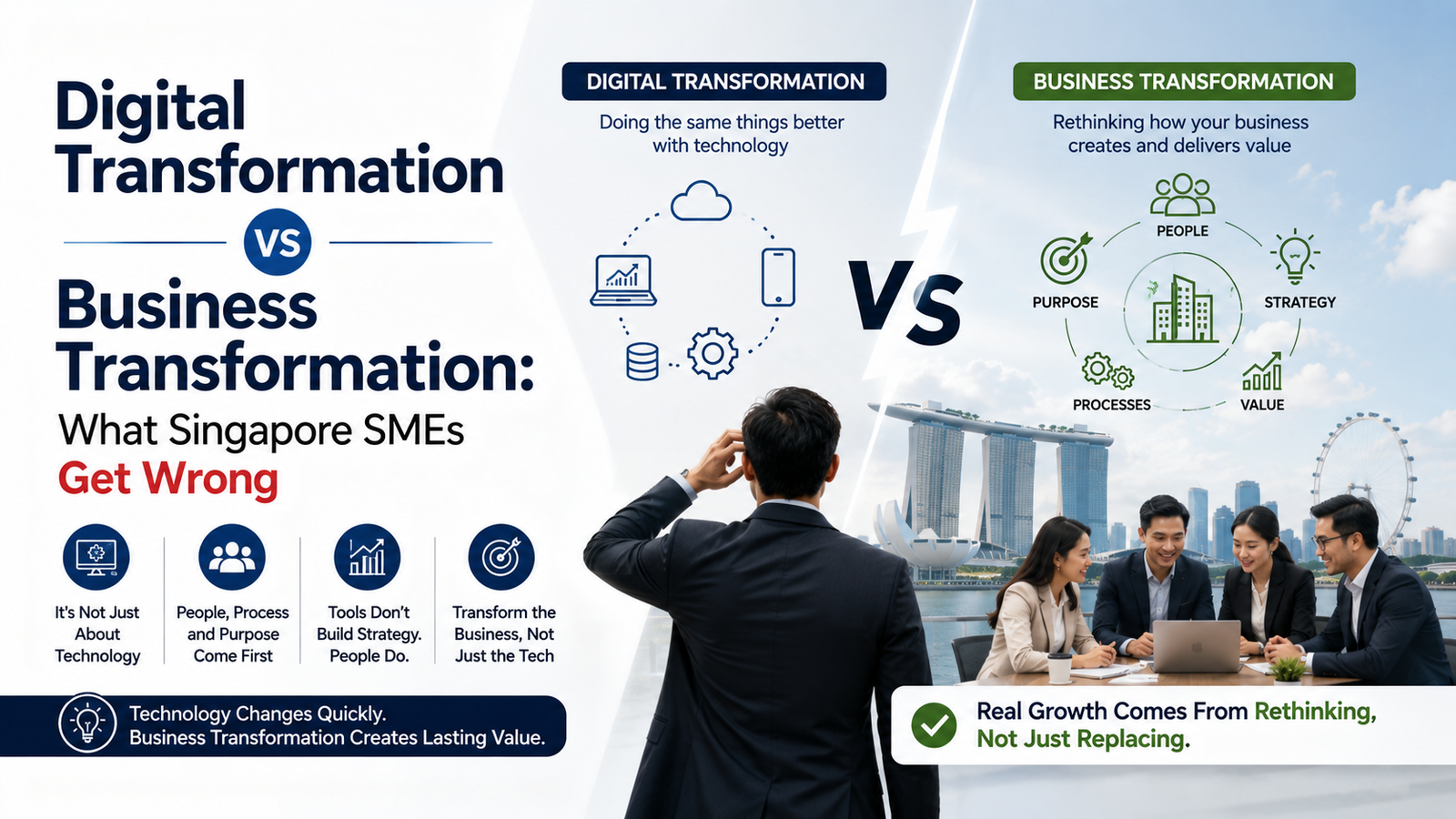
Ask ten SME founders in Singapore what “transformation” means, and most will describe new software — a CRM rollout, an e-commerce platform, an AI chatbot. This is the single most common mistake SMEs make: treating digital tools as the destination instead of the vehicle. Real business transformation is a strategic shift in how a company operates, thinks, and grows. Digital transformation is just one lever within it — and confusing the two is quietly costing Singapore SMEs their growth potential.
The Core Difference, Defined Clearly
Digital transformation and business transformation are related, but they are not interchangeable.
- Digital transformation refers to adopting new technology — software, automation, digital platforms — to improve how existing processes run.
- Business transformation refers to a broader, structural shift in strategy, operations, leadership, and culture, of which digital tools are only one component.
Put simply: digital transformation asks “how do we do this faster with technology?” Business transformation asks “should we even be doing this the same way at all?”
An SME can digitize every process it has and still be fundamentally stagnant — because the underlying strategy, sales approach, and leadership structure never changed.
Where Singapore SMEs Get It Wrong
Mistake 1: Buying Software Instead of Fixing Process
Many SMEs invest in a new CRM or automation tool expecting it to solve a growth problem, without first diagnosing what’s actually broken. A CRM doesn’t fix an inconsistent sales process — it just digitizes the inconsistency. Technology amplifies whatever process it’s layered onto, good or bad.
Mistake 2: Treating Transformation as an IT Project
When transformation is delegated purely to the IT or operations team, leadership and sales strategy stay untouched. But most stagnation isn’t a technology problem — it’s a strategy, structure, or people problem. True business transformation in Singapore requires leadership involvement from day one, not just technical implementation after the fact.
Mistake 3: Expecting Tools to Replace Strategy
A booking system, an automated invoicing tool, or a marketing dashboard can make an inefficient business run faster — but faster isn’t the same as better. Without a clear strategic direction, digital tools simply help SMEs do the wrong things more efficiently.
Mistake 4: Ignoring Culture and Decision-Making
Software doesn’t change how decisions get made, how accountable teams are, or how founders delegate. These are cultural and structural issues that sit entirely outside the scope of digital tools, yet they’re often the biggest blockers to scale.
Why This Confusion Costs SMEs Growth
When SMEs conflate the two, transformation budgets get spent on the wrong priorities. A founder might invest heavily in a new e-commerce platform while the actual bottleneck — an undocumented, founder-dependent sales process — remains untouched. The result: new technology, same ceiling.
This mismatch is particularly costly in Singapore’s SME landscape, where:
- Competition is dense and customer expectations shift quickly
- Talent and operating costs are rising, making inefficiency expensive
- Government grants often fund digital adoption specifically, tempting founders to lead with tech rather than strategy
Business transformation in Singapore needs to start with strategic clarity — then use digital tools to execute that strategy, not define it.
What Proper Business Transformation Actually Looks Like
A structured transformation approach typically sequences change in this order:
Step 1: Diagnose Before Digitizing
Before any tool is purchased, a proper diagnostic should map:
- Where revenue is actually being lost in the customer journey
- Which processes depend entirely on the founder
- Where sales and marketing messaging is misaligned with what customers actually need
Step 2: Fix Strategy and Structure First
This includes:
- Documenting core processes so they’re not trapped in one person’s head
- Building a consistent, repeatable sales framework
- Clarifying decision-making authority across the leadership team
Step 3: Layer in Digital Tools to Support the New Structure
Only once the strategic and operational foundation is clear should digital tools be introduced — as an accelerant, not a starting point. A CRM implemented after a sales framework is defined captures and reinforces good process. Implemented beforehand, it just digitizes confusion.
Step 4: Build in Accountability and Review Cycles
Sustainable transformation includes regular performance reviews tied to clear metrics, ensuring that both the new strategy and any digital tools continue delivering results rather than becoming shelfware.
How to Tell If You’re Doing Digital Transformation Instead of Business Transformation
A few honest questions can reveal which one is actually happening:
- Did we define our strategy before choosing our tools, or after?
- Has our sales process actually changed, or just moved onto a screen?
- Are leadership decisions still bottlenecked through one person?
- Would our core problems still exist if we removed all the new software?
If the answer to that last question is yes, the business has undergone digital adoption — not transformation.
Getting the Sequence Right
The SMEs that scale successfully in Singapore are rarely the ones with the most advanced tech stack. They’re the ones that got the sequence right: strategy first, structure second, technology third. For founders who want to move beyond digitizing old problems and build a business that genuinely scales, working with a firm that understands both the strategic and operational sides of transformation — like Motivus Consulting — makes the difference between spending on tools and investing in growth.
Learn more about structured transformation approaches at motivusconsulting.com.
FAQs
- What is the difference between digital transformation and business transformation?
Digital transformation is the adoption of technology to improve existing processes, while business transformation is a broader strategic shift covering operations, leadership, culture, and strategy — of which digital tools are just one part. - Can a business be digitally advanced but not transformed?
Yes. Many SMEs adopt modern software while their underlying strategy, sales process, and leadership structure remain unchanged, meaning the core business hasn’t actually transformed. - Why do Singapore SMEs often confuse the two?
Because digital tools are tangible, fundable through grants, and quick to implement, they’re often mistaken for transformation itself, while the deeper strategic work gets overlooked. - Should digital tools come before or after a business strategy is defined?
After. Digital tools work best when they support and reinforce a clearly defined strategy and process — implementing them first often just digitizes existing inefficiencies. - Is business transformation more expensive than digital transformation?
Not necessarily. Business transformation often starts with diagnostics and process changes that cost less than software licensing, while delivering more durable results. - How long does business transformation take compared to a digital rollout?
A digital tool can be implemented in weeks, but genuine business transformation — covering strategy, structure, and culture — typically takes 3–12 months to embed properly. - What’s the first step an SME should take before investing in new technology?
A structured diagnostic to identify where revenue is being lost and which processes are bottlenecked, ensuring any technology investment solves the right problem. - Does business transformation always involve digital tools?
Not always immediately. Some transformations start entirely with process, sales, and leadership changes, with digital tools introduced later to scale what already works. - How can I tell if my SME needs business transformation rather than just a software upgrade?
If core problems like founder dependency, inconsistent sales results, or reactive decision-making persist despite recent technology investment, the issue is structural, not digital. - Who can help Singapore SMEs sequence digital and business transformation correctly?
Consulting firms experienced in both strategic and operational transformation, such as Motivus Consulting, can help SMEs prioritize the right changes in the right order.
