

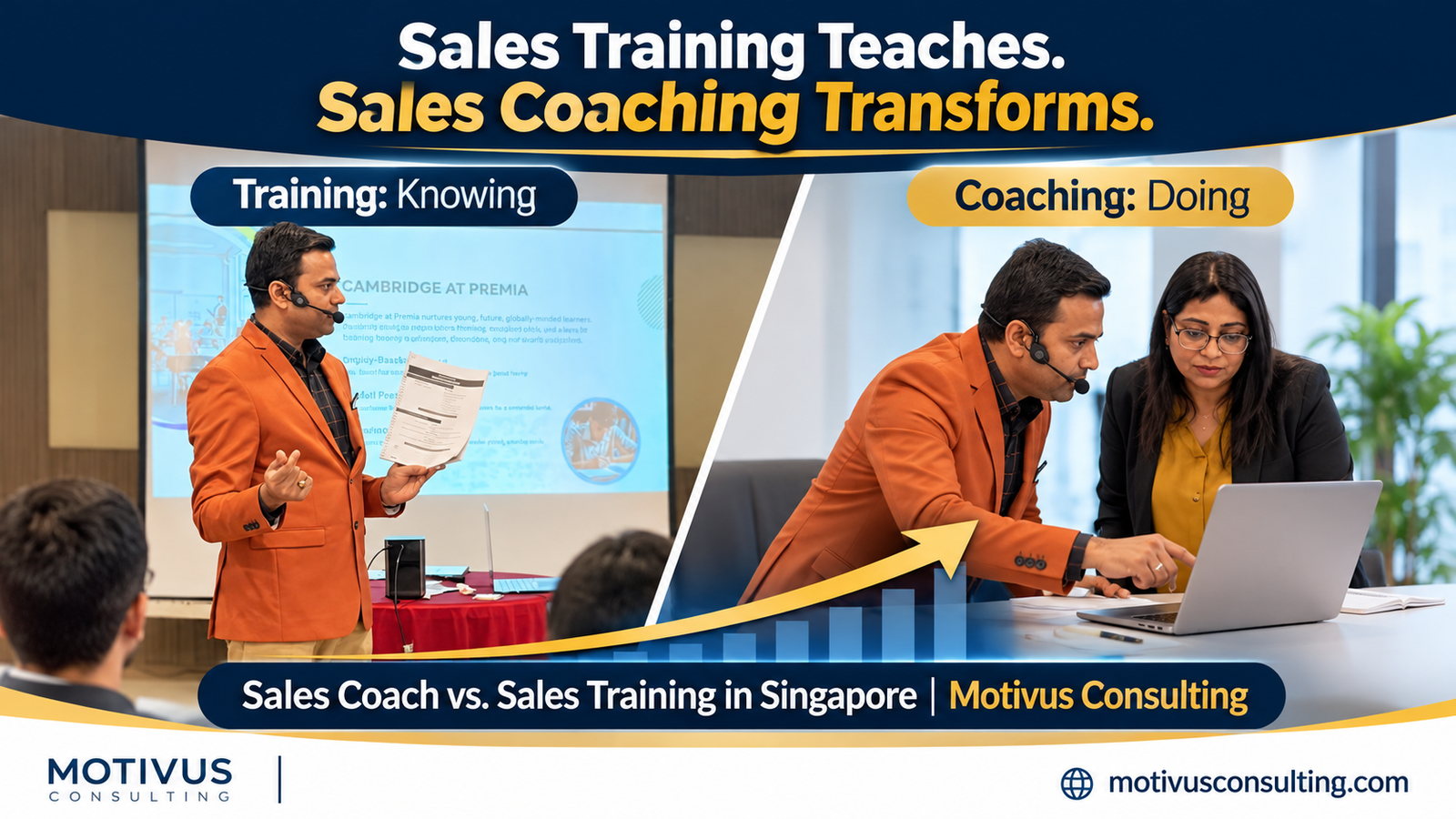
Sales Coach or Sales Training: Which Grows Revenue Faster in Singapore?
Most Singapore business owners have been through this cycle. The sales team attends a two-day workshop, everyone leaves energised, and for a couple of weeks the numbers look promising. Then old habits creep back and results flatten. The money was spent, the slides were good, but revenue did not move.
The problem is rarely the team’s effort. It is usually the method. Training and coaching are often used as if they were interchangeable, yet they solve different problems. Choosing the wrong one, or using only one, is a common reason sales growth stalls.
This guide explains the difference between a sales coach and sales training, when each works best, and what Motivus Consulting recommends for businesses that want faster, more lasting revenue growth.
What Is Sales Training?
Sales training is structured instruction that teaches a group of people a defined set of skills, knowledge or processes. It is usually delivered in workshops, courses or programmes over a short period.
Typical sales training topics include:
- Product knowledge and positioning
- Prospecting and lead qualification
- Presentation and pitching techniques
- Objection handling frameworks
- CRM usage and sales process basics
Best for: onboarding new hires, introducing a new product or process, and closing knowledge gaps across a whole team quickly.
Limitation: training transfers information, but it does not guarantee that people apply it. Without reinforcement, much of what is learned fades within weeks.
What Is a Sales Coach?
A sales coach works with salespeople and sales leaders over time to improve how they actually sell, using real deals, real conversations and real pipeline challenges. Instead of teaching generic content, a coach observes behaviour, gives targeted feedback and holds people accountable for change.
A sales coach typically helps with:
- Diagnosing why specific deals stall or are lost
- Improving discovery conversations and questioning skills
- Building confidence in pricing and negotiation
- Strengthening follow-up discipline and pipeline management
- Developing sales managers who can coach their own teams
Best for: turning knowledge into consistent behaviour, improving individual performance and building a sustainable sales culture.
Limitation: coaching takes time and commitment, and it works best when the foundational skills are already in place.
Sales Coach vs. Sales Training: Key Differences
| Factor | Sales Training | Sales Coach |
| Focus | Knowledge and skills | Behaviour and results |
| Format | Workshops, courses | Ongoing sessions, live deal reviews |
| Audience | Groups | Individuals, managers and teams |
| Customisation | Often standardised | Tailored to your business |
| Duration | Short-term | Medium to long-term |
| Reinforcement | Limited | Continuous |
| Typical outcome | Awareness | Lasting behaviour change |
In simple terms, training tells people what to do. Coaching helps them do it consistently under real pressure.
Why Training Alone Often Fails to Grow Revenue
Many Singapore SMEs invest heavily in sales training and see disappointing returns. The usual reasons are:
- No follow-through: people return to their routine within weeks
- Generic content: examples do not match your market, buyers or sales cycle
- No manager reinforcement: leaders cannot coach the new skills, so nothing sticks
- No accountability: nobody checks whether behaviours changed
- Wrong diagnosis: the team is trained on skills when the real issue is mindset, process or leadership
Training can be a valuable starting point. It simply cannot do the whole job alone.
Why Coaching Delivers Faster, More Lasting Growth
A sales coach closes the gap between knowing and doing. Coaching tends to produce stronger revenue impact because it:
- Works on live opportunities, so improvements show up in the pipeline immediately
- Provides specific feedback on how each person sells, not general advice
- Builds habits through repetition and accountability
- Develops managers, so improvement continues after the coach leaves
- Adapts as results emerge, instead of following a fixed curriculum
For businesses that need revenue to move within months rather than years, coaching tied to real deals is usually the faster path.
What Motivus Recommends: Train First, Then Coach
At Motivus Consulting, we do not see this as an either-or decision. Our recommendation for most Singapore businesses is a blended approach:
Step 1: Diagnose.
Identify where revenue is actually leaking. Is it lead quality, discovery conversations, proposal conversion, pricing confidence or follow-up discipline?
Step 2: Train the foundations.
Where there are real skill or knowledge gaps, deliver short, focused training on those specific areas only.
Step 3: Coach for application.
Move quickly into coaching on live deals, so new skills are practised, refined and turned into habits.
Step 4: Equip managers.
Teach sales leaders to coach their own teams, so growth does not depend on outside support forever.
Step 5: Measure and adjust.
Track conversion rates, pipeline velocity, deal size and revenue, and refine the approach based on results.
This sequence uses training for what it does best, which is spreading knowledge, and coaching for what it does best, which is changing behaviour.
Choosing the Right Option for Your Business
Use this quick guide:
Choose sales training if:
- You are onboarding a batch of new salespeople
- You are launching a new product or sales process
- The team clearly lacks specific knowledge or skills
Choose a sales coach if:
- Your team knows what to do but does not do it consistently
- Individual performance varies widely
- Managers struggle to develop their people
- Deals stall in the same stages repeatedly
- Revenue has plateaued despite previous training
Choose both if:
- You want rapid skill uplift and lasting behaviour change
How to Choose a Sales Coach or Sales Training Coach in Singapore
When evaluating a sales training coach in Singapore, look for:
- Real sales experience: someone who has sold and led sales teams, not just taught theory
- A diagnostic approach: a coach who studies your pipeline before proposing a plan
- Customisation: methods adapted to your industry, buyers and sales cycle
- A focus on measurable results: agreed targets such as conversion and revenue
- Manager development: a plan to build internal coaching capability
- Honest feedback: willingness to challenge your assumptions
Be cautious of providers who offer a fixed programme without understanding your business, or who measure success by attendance rather than results.
How Motivus Consulting Supports Sales Growth in Singapore
At Motivus Consulting, we work with Singapore founders, SME owners and sales leaders who want predictable revenue, not just motivated teams. As a trusted sales training coach in Singapore, we combine focused training, hands-on coaching and manager development so that new skills turn into lasting results.
If your team has been trained but your numbers have not moved, the missing piece may be coaching, and that is where we can help.
Frequently Asked Questions
- What is the difference between a sales coach and sales training?
Sales training teaches skills and knowledge to groups in a structured format. A sales coach works with individuals and teams over time on real deals to build consistent behaviour change and improve results. - Is a sales coach better than sales training?
Neither is universally better. Training suits knowledge gaps, while coaching suits behaviour and consistency gaps. Most businesses get the best results by combining both. - When should I hire a sales coach?
Consider hiring one when your team knows what to do but does not do it consistently, deals stall repeatedly, performance varies widely or revenue has plateaued after training. - What does a sales coach do?
A sales coach diagnoses sales challenges, observes how people sell, gives targeted feedback, builds skills in areas such as discovery and negotiation, and keeps people accountable for improvement. - How do I choose a sales training coach in Singapore?
Look for real sales and leadership experience, a diagnostic approach, tailored programmes, measurable outcomes and a focus on developing your managers as well as your salespeople. - How long does it take for sales coaching to show results?
Early improvements in conversations and pipeline discipline can appear within weeks. Meaningful revenue impact typically builds over a few months of consistent coaching. - Can sales coaching help SMEs in Singapore?
Yes. SMEs often benefit quickly because small improvements in conversion, pricing confidence and follow-up can directly affect revenue and cash flow. - Why does sales training sometimes fail to deliver results?
Training often fails when there is no reinforcement, manager support or accountability. Without these, people tend to revert to old habits within weeks. - Should sales managers be coached as well?
Yes. Managers who can coach their teams make improvement sustainable, so growth continues beyond any external coaching engagement. - How can Motivus Consulting help with sales coaching in Singapore?
Motivus Consulting offers practical sales coach support and focused sales training for Singapore businesses, combining diagnosis, hands-on coaching and manager development. Visit https://motivusconsulting.com/ to get started.
Want faster, more consistent revenue growth? Speak with Motivus Consulting about sales coaching and training in Singapore.
