

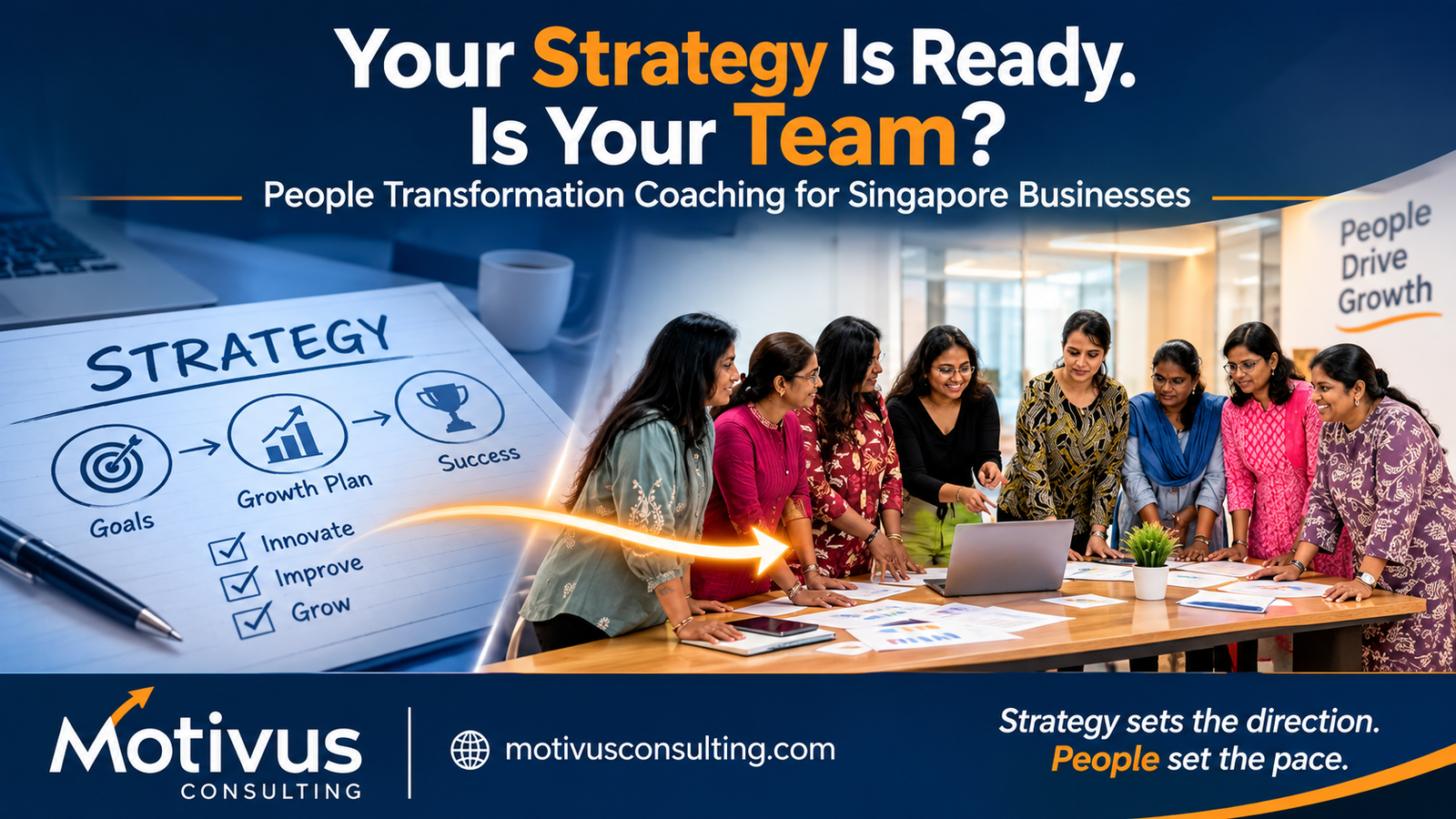
Why People Transformation Decides Whether Growth Happens
Most Singapore business owners can show you a solid strategy. It has a clear market, a sharp offer and a growth target for the year. Yet many of those plans stall, and the reason is rarely the plan itself. The people expected to carry it out were never prepared to do so.
People transformation is the structured shift in how your team thinks, behaves, communicates and takes ownership, so that strategy turns into daily action. In short, strategy tells people where to go, and people transformation determines whether they actually move.
For SME founders and leadership teams in Singapore, this matters more than ever. Talent is tight, competition is regional, and change arrives faster than annual planning cycles. This guide explains what people transformation is, why it outweighs strategy, and how People Transformation coaching helps you build it.
What Is People Transformation?
People transformation is a deliberate effort to change mindsets, habits and capabilities across your organisation. It is different from a one-off training day because it targets the behaviours that drive results.
It typically covers:
- Mindset: moving from “that’s not my job” to full ownership of outcomes
- Skills: building the capabilities your strategy actually demands
- Leadership behaviour: managers who coach rather than control
- Culture: shared norms around accountability, feedback and collaboration
- Systems: goals, reviews and rewards that reinforce the new way of working
When these five elements move together, change sticks. When only one moves, such as a new software tool or a fresh set of targets, the team quietly reverts to old habits.
Why Your Team, Not Your Strategy, Decides Growth
A brilliant strategy delivered by a disengaged team produces average results. An average strategy delivered by an aligned, motivated team often wins. Here is why.
- Strategy is only words until someone acts on it.
Every growth plan depends on hundreds of small daily decisions: how a salesperson handles an objection, how a manager gives feedback, how a support lead handles a complaint. Your team makes those decisions, not your slide deck. - Execution gaps are usually behaviour gaps.
When targets are missed, the instinct is to rewrite the strategy. Often the real issue is that people lack clarity, confidence or accountability. Fixing the plan does not fix the behaviour. - Resistance to change is a people issue, not a process issue.
Teams resist change when they do not understand the “why,” fear losing relevance, or do not trust leadership. No framework solves this without addressing the human side directly. - Culture compounds.
A team that communicates openly and owns its results gets faster and better each quarter. A fragmented team gets slower, no matter how good the roadmap looks.
Signs Your Business Needs People Transformation
Watch for these patterns in your organisation:
- Strong plans that repeatedly fail at the execution stage
- High performers leaving, or quietly disengaging
- Managers who are overloaded because they do everything themselves
- Departments that work in silos and blame each other
- Sales or service quality that varies widely from person to person
- Initiatives that start with energy and fade within weeks
If three or more of these sound familiar, your growth ceiling is probably a people ceiling.
The Cost of Ignoring the People Side of Change
Many transformation efforts fail not because the idea was wrong but because the human side was neglected. The cost shows up in several ways:
- Wasted investment: new tools and processes go unused
- Talent churn: capable people leave when leadership feels unclear or inconsistent
- Slow decisions: teams wait for approval instead of acting
- Stagnant revenue: a team that is not aligned cannot sell, serve or innovate at full capacity
In a market as competitive as Singapore, where good talent has many options, these costs add up quickly.
How People Transformation Coaching Works
People Transformation coaching is a guided, hands-on process that works with your leaders and teams over time, rather than delivering a single workshop. A typical engagement follows these stages:
Step 1: Diagnose.
Start by identifying where the gaps really are. This means looking at leadership behaviours, team dynamics, communication patterns and how goals cascade through the organisation.
Step 2: Align.
Get leadership agreeing on the vision, the priorities and the behaviours that will be modelled. Teams cannot align if their leaders are not.
Step 3: Build capability.
Coach managers and team members on the specific skills your strategy needs, such as consultative selling, feedback conversations, delegation or decision-making.
Step 4: Embed.
Connect new behaviours to goals, reviews and recognition so they become routine instead of temporary.
Step 5: Review and refine.
Measure progress, address what is not working and adjust. Transformation is a cycle, not a project with an end date.
The advantage of coaching over standalone training is accountability. People practise new behaviours on real work, get feedback quickly, and build habits that last.
Where to Start: A Practical Checklist for Singapore Leaders
You do not need a large programme to begin. Start with these actions this quarter:
- Ask your team what blocks them from executing, and listen without defending
- Pick two or three behaviours that would most improve results, and model them first
- Replace vague goals with clear individual ownership
- Train managers to coach, not just supervise
- Review progress monthly, and share wins publicly
- Bring in an outside People Transformation coach when internal blind spots persist
Leaders often find that an external partner sees what the team is too close to notice, and says what staff may not feel safe saying.
How Motivus Consulting Supports People Transformation
At Motivus Consulting, we work with Singapore founders, SME owners and leadership teams who have a strategy but need their people to deliver it. Our approach to People Transformation coaching focuses on leadership behaviour, team alignment and practical capability building, so growth does not depend on the founder doing everything.
If your plans are sound but your results are not, the missing piece is probably your people, and that is exactly where we help.
Frequently Asked Questions
- What is people transformation?
People transformation is the structured process of changing the mindset, skills, behaviours and culture of your team so they can execute strategy effectively and sustain growth. - How is people transformation different from training?
Training teaches a skill once. People transformation changes behaviours over time through coaching, accountability, and systems that reinforce new habits. It targets results rather than attendance. - What is People Transformation coaching?
People Transformation coaching is a guided programme in which a coach works with leaders and teams to build new behaviours, improve alignment and strengthen ownership, using real business challenges as the practice ground. - Why does the team matter more than strategy for growth?
Strategy sets direction, but people execute it. Even strong plans fail if the team lacks clarity, skills or accountability, while an aligned team can make an average strategy succeed. - How do I know if my business needs people transformation?
Common signs include missed targets despite good plans, high staff turnover, siloed departments, overloaded managers and inconsistent customer or sales experiences. - How long does people transformation take?
Meaningful change usually shows within a few months, but embedding it into culture takes longer. Most businesses see best results from a sustained coaching engagement rather than a short intervention. - Is people transformation only for large companies?
No. SMEs in Singapore often benefit most, because founders are closely involved and small shifts in team behaviour can produce a quick, visible impact on revenue and efficiency. - Who should be involved in a people transformation programme?
Leadership must lead it, managers must reinforce it, and team members must practise it. Starting with senior leaders gives the programme credibility and consistency. - How do you measure the success of people transformation?
Look at retention, engagement, execution speed, goal achievement, manager effectiveness and revenue outcomes, tracked before and after the programme. - How can Motivus Consulting help with people transformation in Singapore?
Motivus Consulting provides People Transformation coaching for Singapore businesses, helping leaders align their teams, build capability and turn strategy into consistent results. Visit https://motivusconsulting.com/ to get started.
Ready to turn your strategy into results? Talk to the team at Motivus Consulting about People Transformation coaching for your business in Singapore.
