

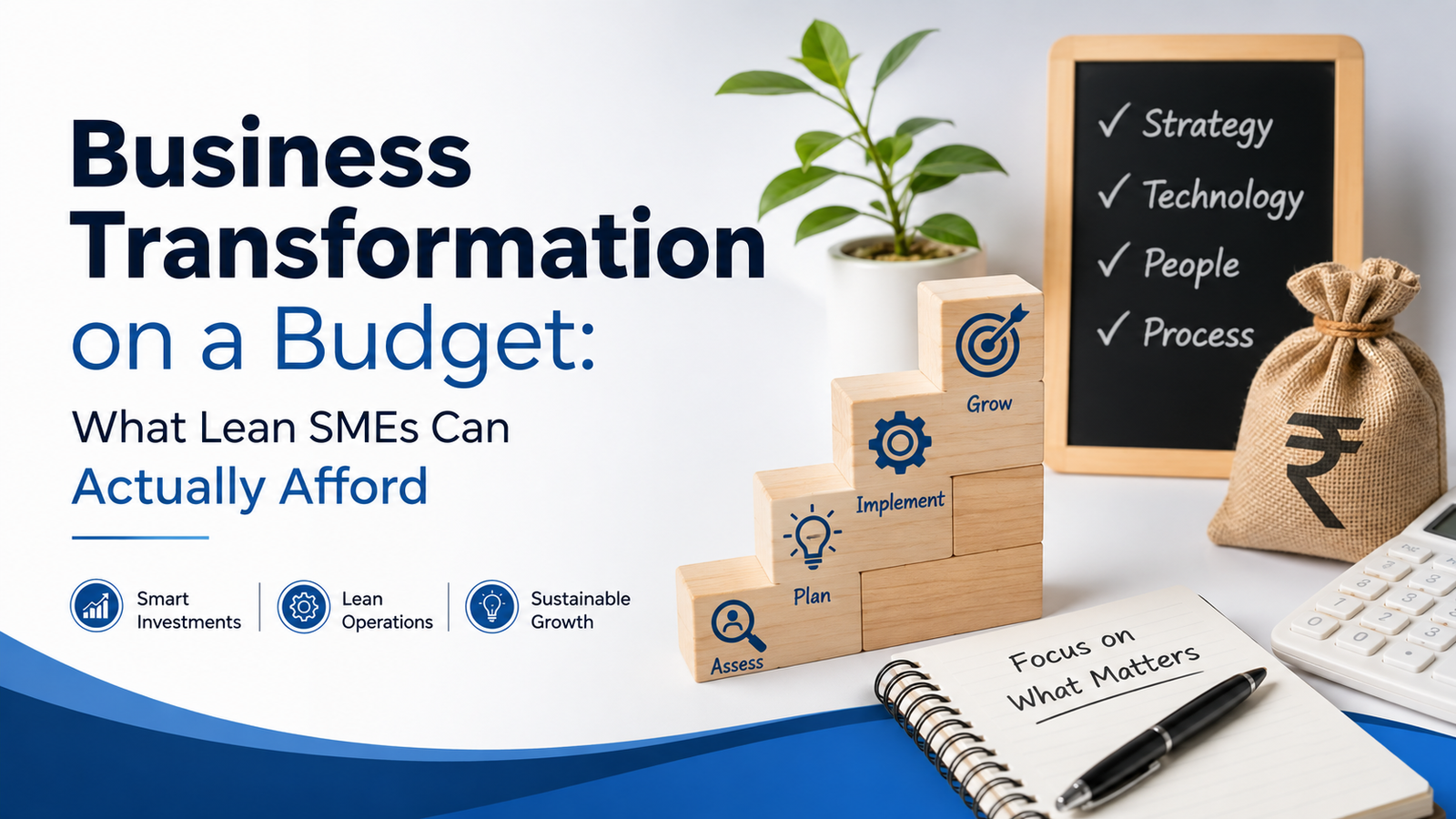
“We’ll transform the business once we have more budget” is one of the most common — and most costly — assumptions lean SMEs make. In reality, the SMEs that wait for a bigger budget to start business transformation often stay stuck the longest. The truth is that meaningful transformation doesn’t require a big-firm price tag. It requires the right sequence of changes, prioritized by impact rather than cost. For resource-constrained SMEs in Singapore, understanding what’s actually affordable — and where to start — makes transformation accessible at any budget level.
Why “No Budget” Usually Means “Wrong Priorities”
Most lean SMEs assume transformation means expensive consultants, enterprise software, and months of disruption. That version exists — but it’s not the only version. Low-cost, high-impact transformation is entirely possible when founders focus on the changes that cost time and discipline rather than money.
The mistake isn’t lacking budget. It’s assuming transformation has to start with the most expensive lever available, rather than the most effective one.
What Actually Drives Cost in Business Transformation
Transformation costs typically scale with three factors:
- Scope — how many parts of the business change at once
- Speed — how quickly the change is implemented
- Outsourcing — how much is delegated to external consultants or agencies versus done internally
Lean SMEs can control all three. Narrowing scope, extending timelines, and doing more internally are all legitimate ways to pursue business transformation in Singapore without a large budget.
Free and Low-Cost Transformation Levers Every SME Can Use
Lever 1: Process Documentation
This costs nothing but time, yet it’s one of the highest-leverage transformation activities available. Documenting how core tasks actually get done:
- Reduces founder dependency
- Makes onboarding faster and more consistent
- Reveals inefficiencies that were previously invisible
- Creates a foundation for any future automation or hiring
A simple shared document outlining “how we do X” for each core process is a legitimate first step in transformation — no software purchase required.
Lever 2: Structured Decision-Making Frameworks
Founders can clarify decision-making authority internally at zero cost:
- Define which decisions each role can make independently
- Set clear escalation paths for decisions that need founder input
- Communicate these boundaries clearly across the team
This single change often reduces bottlenecks faster than any paid tool, because it removes the default habit of routing every decision through one person.
Lever 3: Revenue and Process Diagnostics
Before spending on anything, a focused internal audit — even a simple one — can reveal exactly where transformation effort should go. This includes:
- Reviewing where deals are lost in the sales pipeline
- Identifying which processes rely entirely on one employee
- Auditing customer feedback for recurring complaints
- Mapping where time is spent versus where value is created
This diagnostic step costs nothing but focused attention, and it prevents SMEs from spending limited budget on the wrong priorities later.
Lever 4: Phased Implementation Instead of Full Overhaul
Rather than transforming every function simultaneously, lean SMEs can sequence change:
- Start with the single highest-impact bottleneck
- Implement, measure, and adjust before moving to the next area
- Reinvest early wins (time saved, revenue gained) into the next phase
This phased approach turns transformation into a self-funding process rather than a large upfront expense.
Where It Makes Sense to Spend
Not everything can be solved internally, and some investment is usually worthwhile once the basics are in place. High-value spending areas typically include:
- Targeted external expertise for diagnostics or strategy, where an outside perspective identifies blind spots founders can’t see themselves
- Specific tools that solve a proven bottleneck — not general-purpose software bought speculatively
- Leadership coaching for managers stepping into roles they haven’t been trained for
The key principle: spend only once a diagnostic has clearly identified where the money will have measurable impact — not before.
Why Budget-Conscious Transformation Matters in Singapore
Singapore’s SME landscape is defined by tight margins, rising operating costs, and intense competition for both customers and talent. This makes business transformation in Singapore less of a luxury and more of a necessity — but it also means founders can’t afford to spend transformation budget inefficiently. Fortunately, government-backed SME grants and advisory schemes can offset some costs of formal support, making structured transformation more accessible than founders often assume.
A Simple Starting Framework for Lean SMEs
For SMEs working with limited resources, a practical sequence looks like this:
- Diagnose first — identify the single biggest bottleneck to growth
- Fix internally where possible — documentation, decision frameworks, process clarity
- Spend selectively — bring in outside expertise only where internal effort has clear limits
- Measure before scaling further — confirm impact before investing in the next phase
This sequence ensures every dollar spent on transformation is directed at a proven priority, not a guess.
Getting Started Without Overextending
Business transformation doesn’t have to mean a six-figure consulting engagement or an enterprise software rollout. For lean SMEs, it starts with disciplined prioritization: fix what costs time before spending on what costs money, and bring in outside expertise only where it will clearly pay for itself. For Singapore founders navigating this on a tight budget, working with a firm that understands how to sequence transformation efficiently — like Motivus Consulting — can help identify exactly where limited resources will have the greatest impact.
Explore more insights and consulting support at motivusconsulting.com.
FAQs
- Can business transformation really be done on a small budget?
Yes. Many high-impact transformation steps — process documentation, decision-making clarity, internal diagnostics — cost time and discipline rather than money, making transformation accessible to lean SMEs. - What’s the most affordable first step in business transformation?
A focused internal diagnostic identifying where the business is losing revenue or time is typically the most affordable and highest-leverage starting point. - Do I need to hire consultants to start business transformation?
Not necessarily at first. Many foundational changes, like documenting processes and clarifying decision-making authority, can be done internally before any external spend is needed. - What drives the cost of business transformation up?
Cost typically increases with broader scope, faster timelines, and heavier reliance on external consultants — all of which lean SMEs can deliberately limit. - Should I invest in software before or after diagnosing my business problems?
After. Buying software before understanding the root problem often means digitizing an inefficient process rather than fixing it, wasting limited budget. - Are there funding options for business transformation in Singapore?
Yes. Singapore offers various SME grants and advisory schemes that can offset the cost of formal transformation support, making structured guidance more accessible. - How do I prioritize what to fix first with limited resources?
Start with the single bottleneck causing the most revenue loss or operational strain, based on a simple internal diagnostic, rather than attempting to fix everything simultaneously. - Is phased transformation as effective as an all-at-once overhaul?
Often more effective for lean SMEs, since phased implementation allows each stage to be measured and refined, and early wins can help fund later phases. - What transformation activities should lean SMEs avoid spending money on early?
Avoid speculative software purchases or broad consulting engagements before a diagnostic has clearly identified where the highest-impact issues actually are. - Who can help Singapore SMEs sequence business transformation affordably?
Consulting firms experienced in phased, priority-driven approaches, such as Motivus Consulting, can help lean SMEs identify where limited budget will have the greatest impact.
